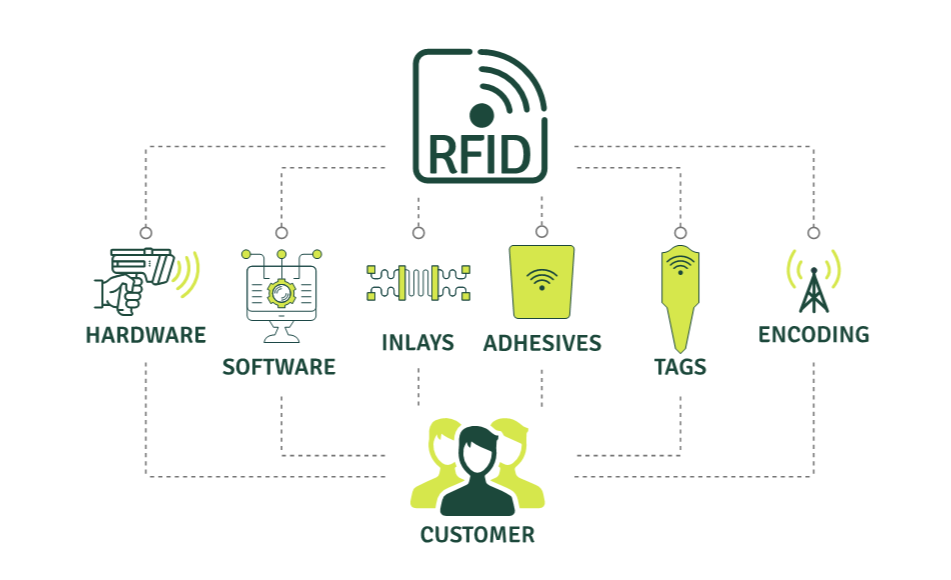
At MasterTag, the goal of Radio Frequency Identification (RFID) is to save growers and retailers time while keeping them from completing tedious tasks. Dan Klute, Manager of Product Management and Development, often compares the technology to a barcode.
“You use barcodes all the time in your daily life. If you’re going through a checkout lane, sometimes you’ll have a barcode that is damaged or unreadable so the scanner just won’t read it,” he explains. “Someone has to come over and help you eventually, and it can be incredibly frustrating. That’s because line of sight is required with a barcode.”
RFID is different because it uses radio frequency technology. That means when an inlay is on a product, it doesn’t have to be seen—it only has to be heard. That’s the main benefit RFID brings to the table: capturing as much data as possible quickly instead of having to scan every single barcode.
It also solves a problem growers rarely talk about: knowing what they actually have in their inventory, and quickly.
Improved Accuracy with RFID
If growers want to know how many items are in their warehouse, they typically depend on manual counts or how many barcodes they scanned themselves. However, that number isn’t always accurate.
“If you’re scanning barcodes, you can unknowingly scan the same barcode multiple times,” Klute says. “So when you do a total count of your inventory, you’ll have as many items as you scanned manually.”
RFID makes sure that count is accurate. The technology uses a unique serial number for every product—every item with an RFID inlay is individually serialized—making it impossible to count the same item twice.
“There are hundreds of thousands of plants in a greenhouse,” he explains. “How in the world could a grower have the time to count those individually?”
Inventory counts are a persistent struggle in the horticulture industry. RFID takes the stress out of the task because it can accurately scan an entire greenhouse filled with plants in just a few minutes.
Putting RFID Into Practice
Klute piloted the technology himself and with a few growers. The main benefit he saw across the board was improved inventory counts. But what surprised him was how little trouble the environment caused, given how sensitive radio frequency can be.
“Radio frequency doesn’t like metal, water, soil, or plant material,” he says. “We are fighting physics in everything we do.”
Greenhouses are full of these conditions, yet Klute didn’t run into those challenges during the pilot tests. That’s because the methods and applications of inlays his team has developed are built to work around common radio frequency obstacles rather than being thrown off by them.
Everything MasterTag is seeing at the lab and in small-scale RFID tests directly transfers to real-world applications. Here’s what that looks like on the ground.
The Numbers That Make Sense
For reference, here’s an internal test Klute did on a cart of 109 plants, comparing plant count and the time it took to go through the process for three methods.
Manual Counting: 32 seconds—109 plants
Barcode Scanning: 79 seconds—111 plants
RFID: 3 seconds—109 plants
Manual counting got the number right but took a while. Barcode scanning was even slower, and less accurate—counting two extra plants along the way. RFID was the fastest by a mile and landed on the exact count. For growers weighing inventory methods, that combination of speed and accuracy is the whole point.
The numbers make RFID sound simple. In practice, it takes a whole lot more than just buying a handheld reader and some off-the-shelf-inlays.
Common Misconceptions About RFID
Most people oversimplify what RFID can do. Many assume that if they have tags and a reader, they can start using the technology right away.
A successful RFID integration is dependent on choosing the right inlays, applying them correctly, and pairing them with compatible hardware and software. MasterTag has invested in research and development to identify the inlays best suited for challenging environments such as greenhouses and production facilities.
“We’ve already completed the testing to identify which RFID inlays, hardware, and software solutions are best suited for each application, ensuring the right fit for every grower’s unique needs,” Klute says. “Ultimately, our goal is to be a one-stop-shop for any grower’s RFID needs.”
Being able to accommodate those differences is what makes RFID unique. If a grower didn’t achieve the desired outcome initially, it doesn’t mean the technology isn’t a good fit. More often, it means the solution needs to be adjusted to accommodate the uniqueness of horticulture environments and their specific operations.
RFID isn’t an off-the-shelf solution, but when the right system is carefully developed and implemented, its capabilities are remarkable. Growers who partner with MasterTag for their RFID needs can achieve what Klute saw in his own trials: reliable counts in seconds instead of minutes. That speed and accuracy make the upfront effort worthwhile.


